
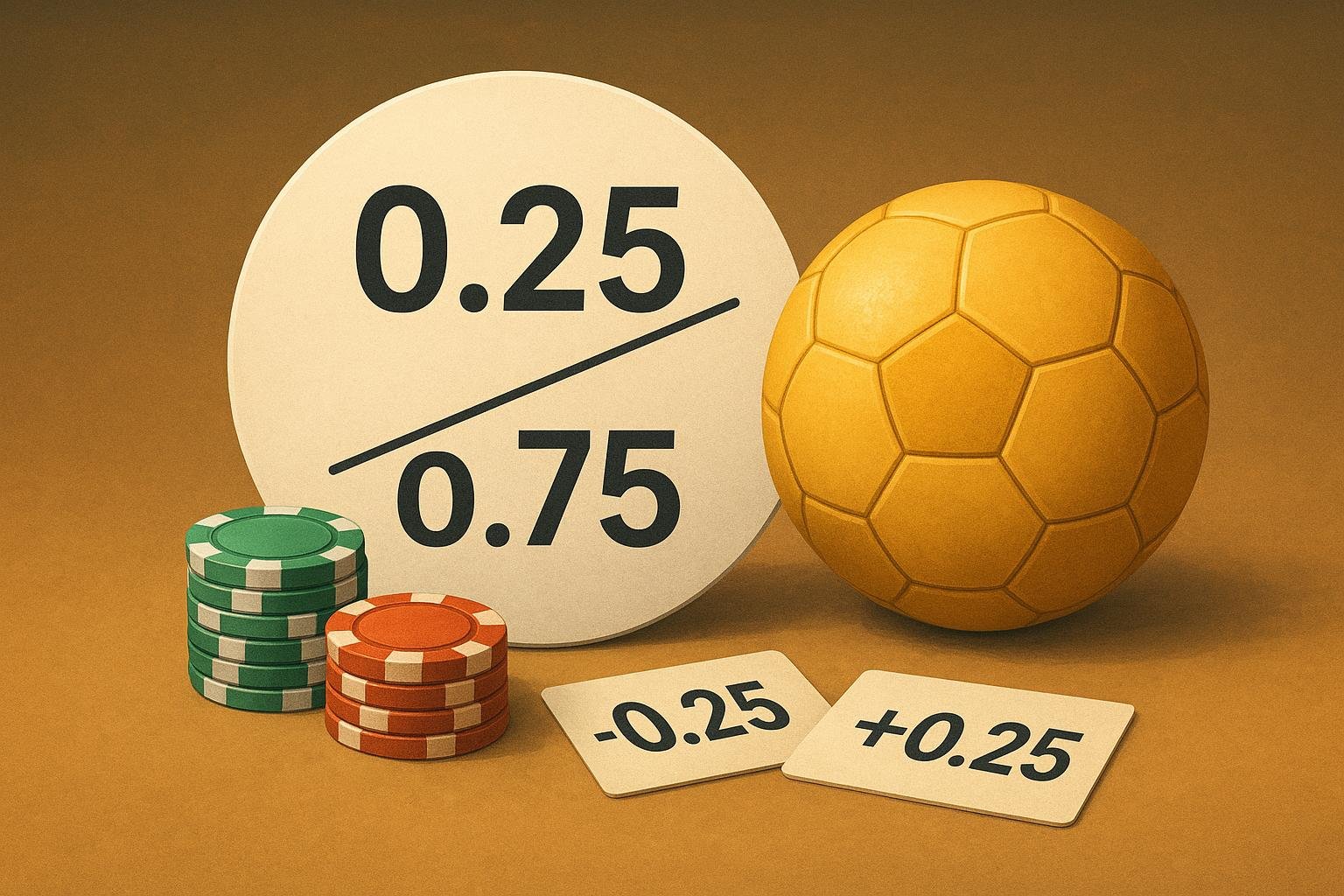
Asian handicap quarter lines can look confusing because they do not settle as a single bet. A line such as -0.25 or +0.75 divides your stake between two neighboring handicap bets. Knowing that split helps you understand what a win, draw or defeat means for the whole wager before you place it.
What a quarter line means
A quarter handicap ends in .25 or .75. It combines the handicap immediately below it with the one immediately above it, splitting the stake evenly. For instance, a -0.25 bet is half on 0 and half on -0.5. A +0.75 bet is half on +0.5 and half on +1.0.
This is different from a whole-number line, which can sometimes be returned as a push if the adjusted result is exactly level. For a broader refresher on how betting prices are expressed, see this guide to sports betting odds.
How -0.25 settles
Suppose you stake $20 on a team at -0.25. The stake is treated as two separate $10 bets: one at 0 and one at -0.5.
- The team wins: both parts win.
- The match is drawn: the 0 handicap part is a push and its $10 stake is returned; the -0.5 part loses. You lose $10 of the original stake.
- The team loses: both parts lose.
The draw is the detail that often catches people out: the wager is neither a full win nor a full loss. The same split-stake idea applies whether the event is football or another sport using handicap markets, but always check the market’s stated settlement rules.
How +0.25 settles
A $20 stake on +0.25 is split into $10 on 0 and $10 on +0.5. If the selected team wins, both parts win. If it loses, both parts lose. If the match is drawn, the 0 portion is pushed and the +0.5 portion wins.
For a simple illustration, at decimal odds of 2.00, that drawn match would return the $10 push stake and the winning $10 portion’s stake plus profit. The total return would be $30, meaning a $10 net profit on the original $20 stake. Actual returns depend on the odds offered and the market’s rules.
What about .75 lines?
The same principle applies, but the two component handicaps sit on either side of the quarter line. A -0.75 bet splits between -0.5 and -1.0. If the selected team wins by exactly one goal, the -0.5 portion wins and the -1.0 portion pushes. That produces a half win: one half earns a profit and the other half is returned.
A +0.75 bet splits between +0.5 and +1.0. If the team loses by exactly one goal, the +0.5 portion loses and the +1.0 portion pushes, resulting in a half loss. These examples use football goal margins; other sports may define the relevant margin differently.
A quick check before placing a bet
- Identify the two handicap lines that make up the quarter line.
- Divide the intended stake equally between them.
- Work through the likely outcomes, including a draw or exact-margin result.
- Check whether the market is settled on regulation time, overtime, or another stated period.
- Confirm the odds format and rules rather than assuming every sportsbook handles markets identically.
It can help to write the split down before comparing prices; that makes the partial win, push or loss easier to see. For more context on football betting terminology, read this overview of football betting. If you are comparing sportsbook features, this article on sportsbook considerations offers a related checklist.
The practical takeaway
Read a quarter handicap as two half-stakes, not as a mysterious single line. Then evaluate each half separately for the result in question. That simple habit makes potential returns and losses clearer, although it cannot change the uncertainty of a sporting result. Set a firm entertainment budget and do not chase losses.


